10Jun

Elevating Excellence: Developing Leaders Named 2026 Professional Training & Coaching Business of the Year

We are incredibly proud to announce that Developing Leaders has been awarded the prestigious title of Professional Training & Coaching Business of the Year 2026 by GPMG!
This global recognition marks a significant milestone for our team. For over two decades, our absolute focus at Developing Leaders has been to equip executives, managers, and emerging talents with the practical skills needed to build high-performance cultures. To be celebrated on an international stage underscores the deep behavioural transformations we help our clients achieve every day.

Our Award-Winning, Four-Pronged Approach
True capability growth requires more than just standard corporate seminars; it demands a structured, holistic framework. Our success as a premier training provider stems directly from our specialised four-pronged methodology:
1. Data-Driven Leadership Assessments
Every breakthrough begins with clear self-awareness. We initiate our frameworks using the Velocity Leadership CheckPoint, our signature diagnostic tool. By measuring 25 distinct leadership behaviours across five core capabilities, this comprehensive assessment uncovers hidden blind spots and establishes a data-backed baseline for targeted growth.
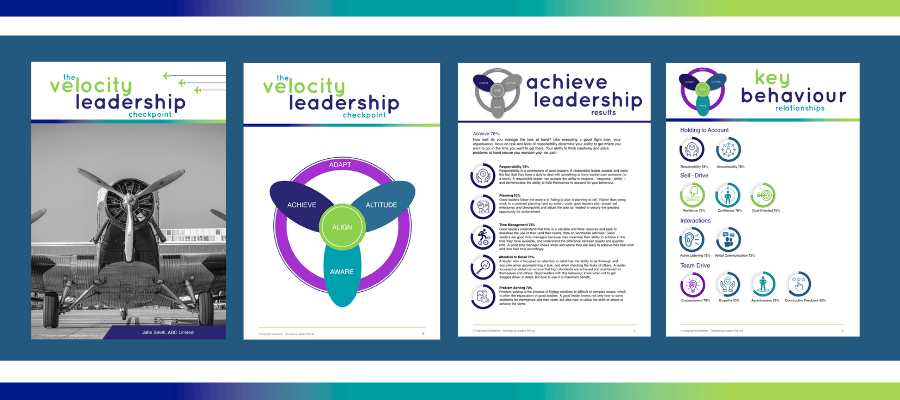
Velocity Leadership CheckPoint - Leadership Assessment Tool for Leaders
The Velocity Leadership CheckPoint Is The Start Point For All of Our Coaching and Programs
2. Bespoke Leadership Coaching
No two executives face the exact same corporate landscape. Our personalised, one-on-one Executive Leadership Coaching dives straight into individual bottleneck behaviours, time-optimisation strategies, and strategic decision-making. We partner closely with organisational heads to align personal capabilities with business targets.
3. High-Impact Leadership Programs
From our flagship public course streams (like the Leadership Essentials Program) to tailored corporate tracks (Building High Performing Teams), our immersive leadership programs bridge the gap between management theory and day-to-day operations. We focus heavily on instilling lasting accountability, driving commercial productivity, and establishing cultural cohesion.
4. Tailored Skills Workshops
Great teams require highly sharp, immediately actionable skill sets. Our experiential workshops target the everyday challenges leaders face—such as mastering difficult performance metrics, building psychological safety, and confidently leading uncomfortable accountability conversations.

What Our Clients Say
While trophies are wonderful, our true benchmark of success will always be the feedback and performance improvements experienced by our clients. Here is what some of our recent graduates have shared on our Developing Leaders Reviews Page:
“Michael’s coaching style was personalised and tailored to my specific needs, encompassing a wide range of essential leadership skills, productivity enhancement, and addressing challenging behaviors. Through his guidance and expertise, I acquired a fresh perspective on leadership…”
— Ali Edwards, Victorian County Court_
“Michael has been a key pillar in helping me perform at my peak, despite high demands, a tight timeline, a team of over 65 staff, and numerous challenges. I couldn’t have done it without him…”
— Matt Nielsen, St Vincents Hospital Melbourne
Our practical skill workshops have driven identical cultural shifts for entire management cohorts:
“The workshops with Michael have been incredibly valuable for our team… I particularly appreciated the balance of discussion, learning, and practical application—it made the sessions both insightful and actionable. I highly recommend Michael’s workshops for anyone looking to refine their leadership skills and elevate their team’s performance!”
— Tiare Kupenga, Vivo

Let’s Start a Conversation
Are you ready to unlock your personal leadership edge or transform the collective performance culture of your corporate team? We make it exceptionally easy to take that next strategic step. Head directly over to our Contact Page to submit a general inquiry, or proactively secure a dedicated time slot on our calendar via our Book an Appointment Page to start a confidential discussion.
Let’s work together to build a thriving workplace culture where accountability drives real, sustainable success.

28May

Bridging the Gap: 5 Core Leadership Insights with Michael Peiniger

A huge thank you to Pedro Henrique Stein and the incredible team at Purple Circle for inviting me onto their podcast, Success Leaves Clues! It was a fantastic opportunity to reflect on my journey with Developing Leaders, discuss current industry trends, and dive into what it takes to build teams that deliver sustained business results. This article is a summary of the podcast – with time stamps to specific references. If you missed the episode, you can catch the full, exclusive interview over on YouTube.
The transition from a 14-year career in the Royal Australian Air Force (RAAF) to a leadership facilitator and Executive Coach has been a true evolution (1:42). It required deep personal learning, moving from group training dynamics to impactful 1-on-1 development, and plenty of navigation along the way (1:42
 To help you apply these concepts to your own professional environment, here are the top 5 answers and leadership insights taken directly from our video discussion:
1. How did your time in the Air Force shape your approach to coaching?
Answer: Fourteen years in the Royal Australian Air Force taught me that leadership is fundamentally about people, not just rank or protocols. In my final military role as Chief Instructor at the Officers’ Training School, I was tasked with designing, developing, and teaching leadership frameworks to individuals ranging from 18 to 52 years old. This vast age gap taught me that true leadership development requires meeting people exactly where they are, understanding their unique drivers, and building a foundation of trust that transcends generational differences.
2. What is the fundamental mental shift required when moving from a training facilitator to an Executive Coach?
Answer: Making the jump from training groups to executing deep 1-on-1 coaching can initially feel like an enormous, terrifying leap. When leading a group workshop of 20 people, it is easy to start a discussion or rely on a collective dynamic to inform the conversation. In a 1-on-1 setting, everything the client is looking for must come from a direct, trusted partnership between you and them. The mental shift means moving away from just telling or instructing a standard curriculum and leaning into different ways of asking deep questions, inquiring, and introducing completely new alternatives and perspectives.

3. Why should business owners clear the “marketing noise” and focus on absolute clarity?
Answer: When I first started the business in 2004, it was called “Kameleons Developing Leaders”. I loved the concept of a chameleon changing with its environment and mood, and our early marketing sat right with that imagery. However, people struggled to find us because the concept of a “chameleon” does not naturally gel with leadership development. While we thought the chameleon represented the ability to adapt to a changing environment, some suggested that it meant flip-flopping from one thing to another. The image and the metaphor clouded the purpose of the business. Ten years ago, we chose to drop the front part of the name entirely. Stepping away from a clever metaphor to focus purely on what we actually do—developing leaders—completely streamlined our positioning and made our website and core message immediately clear to potential clients.
4. How can coaches qualify clients to ensure top-funnel commitment before working together?
Answer: True coaching requires deep mutual commitment. To ensure I only work with highly invested business owners and corporate managers, I established a strict top-of-funnel boundary. I will not work 1-on-1 with a client until they complete a 25-minute online Velocity Leadership Checkpoint (Developing Leaders own leadership profile assessment). This acts as a necessary barrier to entry. If an individual is unwilling to invest just 20 minutes in answering core questions about where they are at, they simply are not going to put in the real work required during the coaching process itself.
5. What are the major challenges corporate leaders face with time and task management?
Answer: While we focus heavily on people leading others, the way executives manage their own day-to-day time and tasks is often incredibly haphazard. Many leaders fall into a destructive routine of firefighting urgency or constantly juggling 15 chaotic workplace balls at once on a whim. This microscopic focus on the current moment causes them to lose their broader vision across their entire team. The goal of coaching is to get leaders to raise their heads above the chaos, establish functional routines, and intentionally carve out structured ground that they can completely control.

Want to dive deeper into your own professional growth journey? Reach out to us directly at Developing Leaders to find out how our Executive Coaching  and Executive Leadership Coaching tracks can help scale your impact, alignment, and team performance!

05May

Empowering Tomorrow’s Leaders: Developing Leaders and Michael Peiniger Celebrated in the 2026 APAC Insider Awards

We are thrilled to share some extraordinary news with our community. Developing Leaders has officially been named the Best Leadership Training Provider 2026 by APAC Insider! Adding to this milestone, our founder, Michael Peiniger, has been honoured with the prestigious title of Leadership Development CEO of the Year 2026: Michael Peiniger.
You can read the official announcement on the APAC Insider Website or view our dedicated profile directly on the APAC Insider Winners Page.
These recognitions mark a proud moment for our team. For over two decades, our mission at Developing Leaders has been simple yet profound: to help individuals become the leaders that others choose to follow. These awards serve as a powerful validation of the real-world impact, passion, and commitment we bring to organisational growth every single day.

What Sets Our Leadership Training Apart?

True leadership is not about a title or a corner office; it is about behaviour, influence, and impact. In today’s fast-paced corporate landscape, organisations cannot rely on outdated, theoretical models. They need practical, measurable, and adaptive skill sets that can not only implemented from day 1, but can grow and adapt within your business culture.
Our success at Developing Leaders stems directly from our specialised, 4-tiered approach to professional growth:
1. High-Impact Leadership Programs
Our flagship frameworks, such as the Leadership Essentials Program, Emerging Leaders Program and the Executive Leadership Program (as well as our popular public and tailored  initiatives), are built to bridge the gap between management theory and day-to-day operations. These comprehensive programs focus on driving accountability, building high-performance cultures, and managing complex organisational changes. By participating, emerging and established executives transform how they interact with their teams, ensuring long-term business success.
2. Tailored Skills Workshops
Great leaders require sharp, actionable skills. Our immersive workshops target the practical tools leaders need to thrive immediately. From masterclasses on difficult performance conversations to strategic sessions on psychological safety and delegation, our workshops provide hands-on training. We focus heavily on experiential learning, giving participants safe collaborative learning spaces to practice real-world scenarios.
3. Bespoke Leadership Coaching
No two leaders face the exact same challenges. Our elite Executive Leadership Coaching coaching services offer personalised, one-on-one partnerships designed to accelerate individual growth. Through rigorous assessments and targeted frameworks, Michael Peiniger and our senior coaching team help executives identify capability gaps, unlock self-awareness, and align their personal values with corporate strategy.
4. Data-Driven Leadership Assessments
Great leadership starts with self-awareness. We begin our transformations with the Velocity Leadership CheckPoint, our premier leadership assessment tool. This rigorous diagnostic uncovers an individual’s hidden strengths, identifies critical capability gaps, and measures behavioural impact. By providing a clear, data-driven baseline, the Velocity Leadership CheckPoint allows us to tailor our training exactly to what each leader—and their organisation—needs most.

A Note of Gratitude from Michael Peiniger
“Receiving the CEO of the Year award is  incredibly humbling,” says Michael. “However, leadership is never a solo journey. This recognition belongs equally to our phenomenal clients who trust us with their cultural transformations. Seeing our clients build high-performance team cultures, lead through uncertainty, and confidently unlock their inner leadership strength is the ultimate ‘feel good’ reward. Thank you to APAC Insider for this honour, and thank you to our community for trusting us to walk this path with them.’
Looking Ahead to the Future of Leadership
As we celebrate these milestones in 2026, the corporate world continues to evolve at a breakneck pace. Between navigating an AI-enabled landscape and managing increasingly hybrid teams, modern executives face unprecedented pressures. Developing Leaders remains fully committed to evolving alongside you. We will continue to innovate our workshops, expand our tailored coaching practices, and refine our core programs to ensure you stay ahead of the curve.

Want to take your team’s capability to the next level?

Explore our upcoming schedules, including our signature public training initiatives, by contacting us HERE or by booking an obligation-free discovery call HERE. Let’s build a culture where your people don’t just work or survive—they thrive.

18Apr

Ensuring Leadership Training ROI at the ASRC

Leadership Training ROI (Return on Investment) is not something many providers focus on when designing a leadership program – yet it is the most important aspect for small to medium-sized businesses seeking to invest in leadership training or coaching. At Developing Leaders, we begin with the end in mind and focus on practical, achievable and relatable leadership content that develops leaders skills from whatever base participants bring – ensuring a leadership training ROI is observable and worth the effort and expense.

For the last 6 months we have had the pleasure to work and learn with 2 Management group and the Executive Group with the Asylum Seeker Resource Centre as we completed 3 separate (and inter-related) leadership initiatives – the Leadership Essentials Program and the Executive Leadership Program. A big thank you to CEO Kon Karapanagiotidis OAM and Head of People and Culture Melissa Milner for providing the opportunity to work and learn with your leadership groups.

We had the opportunity to design a bespoke Leadership Development Program for for leaders and managers who are driven, purpose-focussed and committed to some highly important social causes. To be able to design and facilitate workshops that help leaders be as efficiently and effective as they can be, while also incorporating some ‘experiential’ feedback and learning activities, as been a real pleasure.

Leadership Training ROI

While working with this group as been a joy, the most important aspect of the program is ensuring that it has been effective in developing the skills of the leaders at ASRC. Here are some of the comments from participants across the 3 programs:

 
Interested in the Leadership Essentials Program or the Executive Leadership Program?

Both Programs begin with leaders completing the Velocity Leadership Checkpoint, and completing 1-on-1 debriefs with Michael Peiniger, to establish known strengths and development areas in leadership behaviours. What follows is leadership workshops conducted fortnightly (90 minutes a piece for 4 months for the Leadership Essentials Program and 90 minutes each fortnight for 6 months for the Executive Leadership Program), providing sharp, focussed workshops introducing topics to be debated, discussed and focussed on created some simple. implementable solutions.

The programs are all about creating small, incremental changes to behaviours and routines – both for self, team and business. Taking a successful organisation and seeking to improve behaviours further.

The learning opportunities multiply when you get to work with an Executive group and a Management group at the same time. The opportunity to assist in building culture, communication, community and create a new shared language around leadership, team and difficult conversations is one of the reasons I love doing what I do. It takes something to lead others, be coachable and willing to look at new perspectives, as well as be willing to challenge your own and others behaviours.

If this type of practical, integrated leadership training would have an impact for your leadership and management group, click HERE to book an obligation free discovery call.

04Apr

High Performance Team Workshop Review – Richard Walsh

Following on from a lovely review from Richard Campbell, Managing Director of HydroTerra, we would also like to thank Richard Walsh, Marketplace Sales Manager at HydroTerra for his review of the recent High Performance Team workshop. The Executive Team at HydroTerra worked with our lead facilitator and Executive Leadership Coach, Michael Peiniger, in a series of High Performance Team Workshops in February and March 2026. Thank you for your kind words – it was a pleasure to work and learn with your team in both of the workshops that we completed. We would like to thank both Richard’s for their reviews!

“This training session with Michael was a very good experience. Sitting down with our leader team and having the opportunity to hear everyone’s perspective was really valuable. Michael is a great facilitator and was excellent at steering the conversation to where it needed to go. Highly recommended.”

Richard Walsh, Marketplace Sales Manager at HydroTerra

High Performance Team Workshop Google Review - Richard Walsh HydroTerra
Leadership Development and High Performance Partnership with HydroTerra

Developing Leaders has had a 2 year partnership the Executive Team at HydroTerra. This has included completing Velocity Leadership Checkpoints and 1-on-1 debriefs, completing High Performance Workshops in 2025 and 2026 (including executive and business values, strategic thinking, communication and high performance) as well as targeted Executive Leadership Coaching.

High Performance Team Workshops

Developing Leaders High Performance Team workshops provide leaders and executive teams with knowledge, behaviour and practical skills required to lead and adapt to a changing work environment. That also provide a unique opportunity to share values, learn individual behaviours, strengths and weaknesses, and developed a shared perspective on strategy focus points and ways in which leaders can engage energetically, critically and constructively – all at the same time.

If this sounds like it could be useful for you or members of your Executive team, get in touch with us today via the Contact Page, or via a Discovery Call on Zoom where one of experienced coaches can answer all of your burning questions.

#highperformanceteams #leadership #leadingteams #leadershiptraining #leadershipcoaching #management  #executivecoachingmelbourne #executivecoach #executivecoachmelbourne #leadershiptraining #leadershiptrainingmelbourne #developingleaders #leader #executivetraining #managementtraining


31Mar

High Performance Team Workshop Review – Richard Campbell

We would like to thank Richard Campbell, Managing Director of HydroTerra for his review of the recent High Performance Team workshop. The Executive Team at HydroTerra worked with our lead facilitator and Executive Leadership Coach, Michael Peiniger, in a series of High Performance Team Workshops in February and March 2026. Thank you for your kind words – it was a pleasure to work and learn with your team in both of the workshops that we completed.

“The leadership training focussed on individual’s values and how these play out in a team and leadership context. The session was exceptional in that it really helped us to understand each other and how we work together and why we make the decisions we do. Understanding each other’s values brings a new context to discussions, the why are people responding in the way they are, can be reframed from annoyance to respectful discussion. I would strongly recommend this coaching.”

Richard Campbell, Managing Director at HydroTerra

High Performance Team Workshop Google Review - Richard Campbell HydroTerra
Leadership Development and High Performance Partnership with HydroTerra

Developing Leaders has had a 2 year partnership the Executive Team at HydroTerra. This has included completing Velocity Leadership Checkpoints and 1-on-1 debriefs, completing High Performance Workshops in 2025 and 2026 (including executive and business values, strategic thinking, communication and high performance) as well as targeted Executive Leadership Coaching.

High Performance Team Workshops

Developing Leaders High Performance Team workshops provide leaders and executive teams with knowledge, behaviour and practical skills required to lead and adapt to a changing work environment. That also provide a unique opportunity to share values, learn individual behaviours, strengths and weaknesses, and developed a shared perspective on strategy focus points and ways in which leaders can engage energetically, critically and constructively – all at the same time.

If this sounds like it could be useful for you or members of your Executive team, get in touch with us today via the Contact Page, or via a Discovery Call on Zoom where one of experienced coaches can answer all of your burning questions.

#highperformanceteams #leadership #leadingteams #leadershiptraining #leadershipcoaching #management  #executivecoachingmelbourne #executivecoach #executivecoachmelbourne #leadershiptraining #leadershiptrainingmelbourne #developingleaders #leader #executivetraining #managementtraining


25Mar

The 6 Step Guide to Handling Difficult Conversations at Work

Are you struggling with difficult conversations at work? Have you thought about having a difficult conversation with a peer, colleague or boss, only to put it off, make excuses, or find something else to keep yourself busy with? You aren’t alone! Many leaders avoid tough conversations, but avoiding them can quietly damage trust, performance, and team culture. On a more personal level, it can erode your confidence, spill out into other work relationships as well as an impact on how you are perceived as a leader at work. The reality is simple: avoiding the conversation often does far more damage than having it.

In this guide, you’ll learn a practical, structured framework — the IDRIFT model — to help you handle difficult conversations with clarity, confidence, and impact.

Why Leaders Avoid Difficult Conversations at Work

Howe many reasons would you like? The reasons why leaders avoid difficult conversations at work are often the same reasons why people avoid difficult conversations in their home lives. Most leaders hesitate because they:

  • want to be liked
  • fear conflict (and the pushback after having a conversation)

  • don’t feel confident in what to say

  • hope the issue will resolve itself

In addition to these, you can add:

  • questioning whether it is the leaders problem to deal with
  • worry over intruding in another persons space
  • fear of micromanaging an issue
  • previous experience of a ‘bad outcome’ being brought forward to the present
  • poor relationship (perceived or otherwise) with the person you want to talk to
  • worry about the repercussions from the person (and / or the people around them)

I am sure you can think of several others – that you have both felt yourself and observed in others. Unfortunately, while avoiding a difficult conversation always has impacts, those impacts are amplified as a leader. That is because as a leader, the people around us not only expect us to NOT AVOID a difficult conversation, they expect us to be good at it.

In our teams eyes, when it comes to difficult conversations, Silence reinforces poor behaviour.

The Cost of Avoiding Difficult Conversations

Avoidance might feel easier in the moment, but it usually comes at a cost:

  • underperformance continues (if you seek to avoid it or hope it will correct itself – it rarely does)

  • high performers disengage (due to your inaction on difficult issues)

  • team culture weakens (due to standards not be addressed and maintained and poor performance being tacitly accepted)

  • leaders lose credibility

Key insight: Small issues left unaddressed tend to “drift” into larger problems that require much bigger conversations later.

The IDRIFT Model: A Practical Framework for Difficult Conversations

The IDRIFT model provides a structured way to have difficult conversations without making personal attacks. It provides a structure for the person initiating the conversation to consolidate their thoughts in a logical way, and not letting our immediate emotions rule the way. Used effectively, the IDRIFT model helps bring behaviour, relationships, and expectations back on track while maintaining the dignity of both parties involved. The model is built around six elements: Inoculate, Describe/Define, Result/Repercussion, Intent, Feeling, and Timeframe.

You Must Start With Leadership If You Want To Work On (And Not In) Your Business

1. Inoculate

Prepare the other person for the conversation in tone, style, and setting. This helps reduce a fight-or-flight response and gives both people space to approach the conversation more thoughtfully.

  • “There’s something I’d like to discuss that may be difficult to hear.”
  • “I want to have an important conversation — is now a good time?”

2. Define and Describe

State the facts clearly and objectively. Focus on what happened, not your judgement about the person. The model emphasises using data and examples that cannot easily be disputed.

Example: “On three occasions this week, deadlines were missed.”

3. Result and Repercussion

Explain the impact of the behaviour on you, the team, timelines, or outcomes. The model also encourages clarifying what happens if nothing changes — and what improves if it does. :content

Example: “This has delayed the project and increased pressure on the rest of the team.”

4. Intent

Be clear on your purpose before the conversation starts. The IDRIFT model describes intent as the “stake in the ground” that helps bring the discussion back on track if emotion or defensiveness derails it. 

Example: “My goal is to ensure we can meet deadlines consistently and support the team.”

5. Feeling

Share how the situation makes you feel, but keep the focus on the issue rather than attacking the person. The model notes that naming the real emotion matters, rather than defaulting to vague language like “fine” or “frustrated.” 

Example: “I’m concerned about how this is affecting the team.”

6. Timeframes and Specifics

Be specific about what needs to change and by when. The model highlights the importance of naming what the person should start or stop doing, the expected standard, and the timeframe for change.

Example: “Going forward, deadlines need to be communicated early if they’re at risk, starting this week.”


What Great Leaders Do Differently


  • They address issues early, before they escalate.
  • They stay calm and direct.

  • They focus on specific behaviour, not the person.

  • They use a structured discussion format instead of improvising.

Common Mistakes to Avoid

  • waiting too long
  • being vague

  • over-softening the message

  • avoiding clarity on expectations

How Difficult Conversations Build Trust

Handled well, difficult conversations actually increase trust. Your team sees that you are honest, care about standards, and are willing to lead when it matters.

Final Thought

Difficult conversations are not a leadership failure. They are a leadership responsibility. The best leaders don’t avoid these conversations — they approach them with structure, clarity, and intent.

Next Steps: Do you struggle with difficult conversations?

Developing Leaders includes difficult conversation training in the Emerging Leaders Program, Executive Leadership Program, Leadership Essentials Program and the Performance Management Essentials and Leading Difficult Conversations workshops. The latter includes not only training in the IDRIFT principles, but multiple opportunities to practise and refine your skills in having your won difficult conversations.

_____________________________________________________________________

Michael Peiniger is the owner and lead facilitator at Developing Leaders, focussed on developing people to become the leaders that others choose to follow. A leadership and high-performance teams expert, Michael is a highly sought after speaker, trainer and executive leadership coach who is focussed on developing leadership skills and behaviours through a practical, results driven approach. Michael can be contacted for enquiries or bookings on +61409627270 or leader@developingleaders.com.au or via his website www.developingleaders.com.au


Click Here to Learn more about our leadership coaching

Click Here to Learn more about our Leading Difficult Conversations Workshops

Click Here if you Want to have a quick conversation about how we can help with your difficult conversations?