09Dec

Is Busyness Preventing Your Leadership From Being Better?

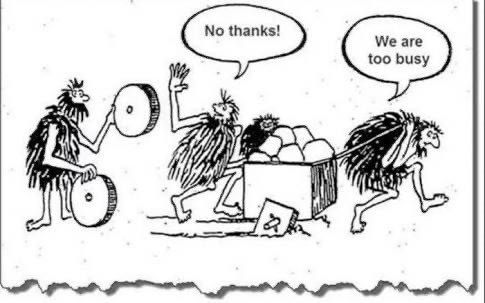
Is busyness preventing your leadership from changing for the better? What are you too busy to change? Sometimes the answer to solving a problem is right in front of us, if only we didn’t ‘filter’ it out and not see it in a state of constant busyness.

When you see this image, what process, system or project in your business / life did you see? This was a question we asked recently in our Executive Leadership Program, and followed up one-on-one in some Executive Leadership Coaching sessions. As highlighted in this recent Forbes article, many leaders have made themselves so busy that they can’t win.

For me, it was a broken task / project management system for completing work. 3 or 4 different systems for allocating and completing work, none that works together – in fact all very quick, short terms fixes to the previous bad system! I had known about this for months but was always ‘too busy’ to fix it properly. My excuse was that ‘it would take too long’, ‘I’ll need to run two systems until I transfer to one’ (despite using 4!), ‘there is more important work to do’ – all excuses seeking to avoid dealing with a problem of my making, that was negatively impacting me.

What Leadership Opportunities For Improvement Are You Avoiding?

So what problem / system or process are you avoiding fixing?

What problem are you ‘too busy’ to fix that impacts you daily?

Trust me – on the other side of dealing with that problem is a far better process – coupled with greater piece of mind.

#avoiding #leadership #change #leadershiptraining #leadershipdevelopment #developingleaders #IMLD

25May

Team Behaviour Out of Isolation – Your Response as a Leader

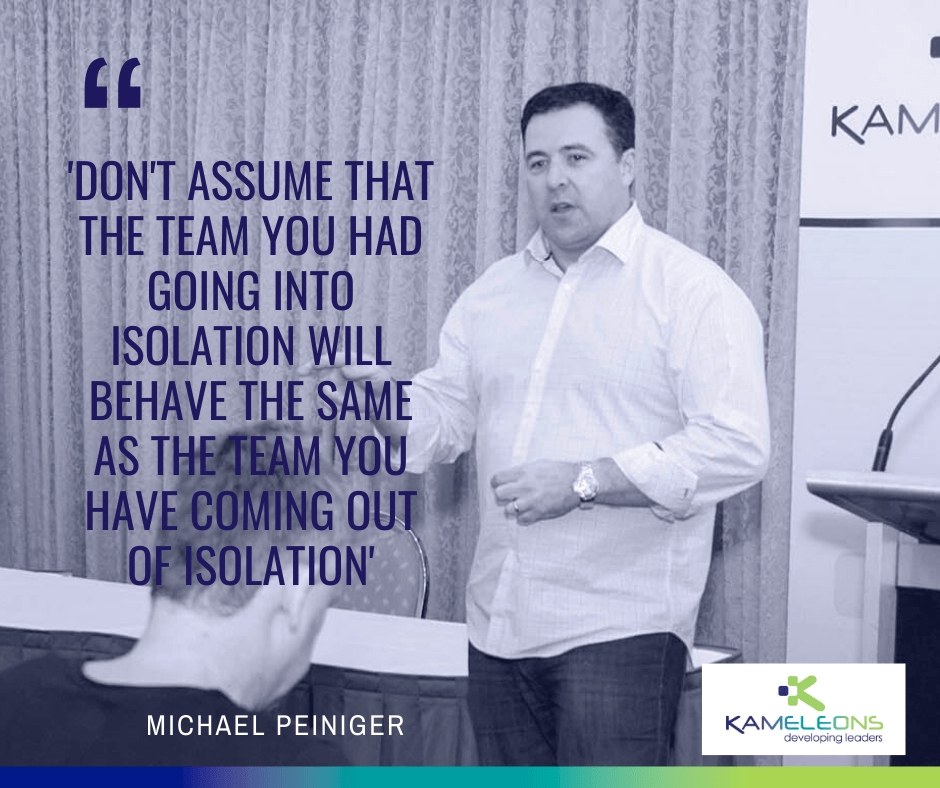
Your response as a leader will have a huge influence on your team behaviour in the next few weeks. Your team will have changed dramatically in the last 8 weeks – beyond schooling arrangements and the comfort / discomfort of working from home or the hours worked. Don’t assume that the team you had going into isolation will behave the same as the team coming out of isolation. Your team members may have a very different relationship with:

🔹You – as both leader, mentor, peer or friend

🔹The business – is the trust still there

🔹Security (both physical and financial)

🔹Challenge – they are looking from work

🔹Autonomy – and micromanagement

🔹How important work is to them overall

🔹The support they are looking from the team

🔹The future they see at your business

There is no need to be afraid of having this conversation with your team – I am sure your relationship as a leader / manager has also changed in relation to a number of the dot points.As a leader, we deal with who we have and the situation in front of us NOW, not what it was. Take the opportunity to bring yourself up to date with your team’s expectations.

#leadership #leadershipdevelopment #leadershipcoach #leader #executivecoaching #coaching #highperformanceteams #developingleaders

12May

Cultural Silos – 4 Reasons For Them and 6 Ways Leaders Can Break Them Down

When it comes to leading managing the dynamics of the people in your team and breaking down cultural silos, near enough is not good enough. When people talk about a business being ‘siloed’ – what they are actually referring to is a business that has created so many people ‘work arounds’ or people ‘avoidances’, that entire business units no longer function effectively. This can stem from something as simple as two Department Heads not liking each other and deciding not to talk. Little ‘work arounds and avoidances – not debating a point you disagree with, avoiding a team member, following an outdated process – all start to add up over time. These people inefficiencies cost businesses millions of dollars in wasted time, effort and frustration, but they are hardly talked about.

Cultural Silos are Created By Leaders

There are 6 simple ways in which cultural silo’s are created by Leaders:

1. People Processes Treated Differently To Business Processes

If a business process is inefficient, businesses utilise principles such as six-sigma or lean to ensure that it is rectified. If the finances of the business are inefficient, a formal review may take place to ensure money isn’t wasted. If safety processes are inadequate, a 5-S process may take place. People inefficiency is treated differently – it is often ignored, done badly, worked around.

2. People Process Ignored Cultural Silos

People behaviours that impact performance can be ignored for many reasons:

  • It seems too easy. ‘This is just common sense’ is a phrase that ignores the simple fact that miscommunication can cause people issues and inefficiency. What is common sense to one person is very different to another – there is no ‘common’ sense. We all have different experiences, emotions, behaviour patterns, preferences and work styles – to assume that something is common sense is really a little naive.
  • Challenging entrenched behaviours can be hard. Very few people actually like conflict – that uncomfortable feeling in your gut when you challenge a behaviour or hold someone to account for something that hasn’t been completed. Instead of feeling uncomfortable in the moment, it can be easier to ignore the problem until it comes up again.

3. People Process ‘Worked Around’

  • It isn’t as important as the bigger things. One of the reasons that a people process is not dealt with is a simple justification – ‘it isn’t important’ or ‘it isn’t as important as xxx’. This often masks a personal discomfort with having a difficult or uncomfortable conversation. People issues and misunderstandings can have a significant impact on performance – choosing to work around them because they seem less important than other things just creates a bigger problem in the future.
  • Collusion. Many people behaviour are ignored for a very simple reason – the leader / manager may have done the same thing themselves. Rather than discussing the problem, they avoid it for fear of what might be said back to them – ‘but, you do that as well’. It results in behaviour collusion – I won’t mention your behaviour if you don’t mention mine – a pattern that can spiral a teams performance.

4. People Process Done Badly

  • It gets Personal. Often when Managers and Leaders seek to address a people problem, they make a fundamental error. Knowingly, unwittingly or accidentally, they  attribute a problem behaviour is attributed to a ‘problem person’. It gets personal. The focus becomes the person (and the implicit judgement of the person that comes with it) rather than the correction or adjustment of the behaviour that caused the issue int he first place. A minor correction in behaviour then becomes a major problem between people – in football parlance, it would be called ‘playing the person, not the man/woman’.
  • It Gets Judgemental. When people issues are raised poorly, people can feel criticised or judged, and their behaviour often fits a familiar pattern – fight (argue, talk back or get angry), flight (don’t listen, avoid or leave) or stand still (hear the words, but are so threatened or surprised by the information, they don’t respond). Responses can be delayed, shared with other people after the fact, or not discussed again bu the people that need to. After a poor interaction, there is a tendency to judge the other person – ‘A always says this’, or ‘B never does the following’ – resulting in a people problem that two people will not attempt to solve.

How Do Leaders Break Down Cultural Silos?

Breaking down solids on a business requires persistent and clear behaviour from all staff, particularly those in senior positions. As mentioned in a recent Forbes article, these behaviours can have large negative consequences. Some of things that can be done to address silo behaviour include:

  1.       Be clear on what you want. Being clear on the behaviour that you want people to demonstrate, as well as clear on the behaviour that is inappropriate. Think on the things that you love your team to do, and well as what you don’t – then tell them.
  2.       Don’t walk past small misunderstandings. Small misunderstandings turn into big misunderstandings and judgements over time – take to time to talk clearly with people if there has been a disagreement or misunderstanding and clarify it quickly.
  3.       Play the Ball, Not the Person. When raising an issue, focus on the behaviour that you want to discuss and how you want it changed, rather than focussing on the person. The person doesn’t need correcting or changing – only the behaviour.
  4.       Avoid ‘Absolute’ Judgements. If someone has made a mistake or done something wrong in the past – it does not mean they should be judged for it forever. Discuss a behaviour, let the person correct it, and move on. If they do the same behaviour again, mention it and correct it again – and be clear why you are doing it.
  5.       Acknowledge Your Errors. There are times when you have to discuss a siloed behaviour that you have done yourself. Acknowledge your behaviour and correct it anyway – and don’t be a hypocrite. Just because you have done something before doesn’t mean that you need to do it again, and neither does the person you are correcting.
  6.       Seek to Understand. Silo’s are not created by bad people – they are most often created by passionate, driven people trying to look after their people. Take the time to understand what the other person / team wants and needs and don’t judge focus on your own needs – you will be far less likely to create a misunderstanding.

Silo’s can be broken down when leaders and managers take the time to not walk past the little things and make relationships between people an important part of business success.

Related IMLD Articles:

a.       Negative Culture = Negative Leadership

b.       The 5 Things Supervisors want from their senior managers

c.       5 Leadership Development Lessons Business can learn from the military

23Apr

Leadership & Executive Coaching Clients – Thank You

A huge thank you to our leadership and executive coaching clients for your recent google reviews. Despite the difficulties that COVID19 has brought to countries and economies and families, there is still a lot to be grateful for. Health and emergency services workers, Defence personnel and businesses staying open above and beyond normal hours to provide essential services for those in need. In our world, we are also grateful for those business owners, CEOs and Managers that we are working with through this tough time – the effort and care you are putting in for your businesses and teams is making a difference. We are also grateful for our clients taking the time out of their busy days to appreciate what we have been doing for them – the Google reviews and comments have been greatly appreciated and have spurred us on to do even more. Thank you

28Aug

Cultural ’Silo’s’ Damage Your Team & Business Culture – 6 Reasons For Them And How to Address Them

‘There are so many silo’s in our business – we don’t seem to get anything done. We spend all of our time working around people instead of just getting the job done’

Does this sound familiar?

I was recently asked by an MD of a large manufacturing business to help them ‘with their teamwork’. When he mentioned the dreaded word ‘silo’ and ‘negative culture’ in the same sentence, I could see that the people dynamic of his business had become difficult to manage and inefficient – hardly what he expected when he started growing the business 3 years before.